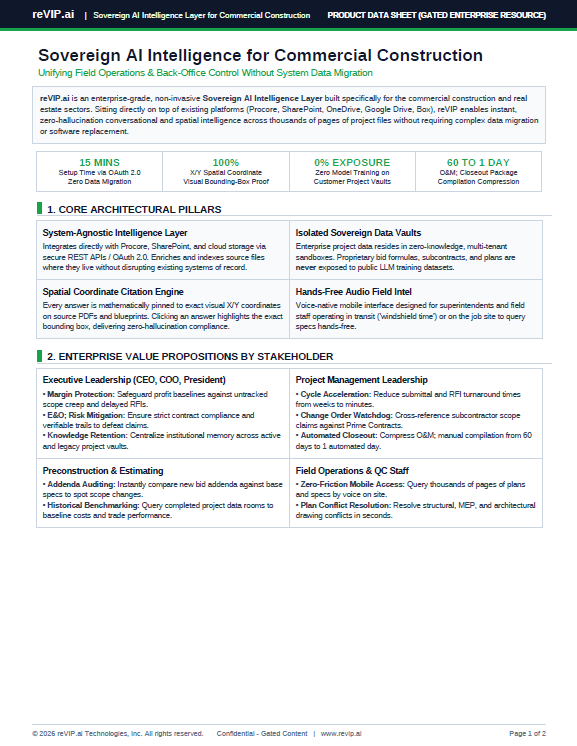
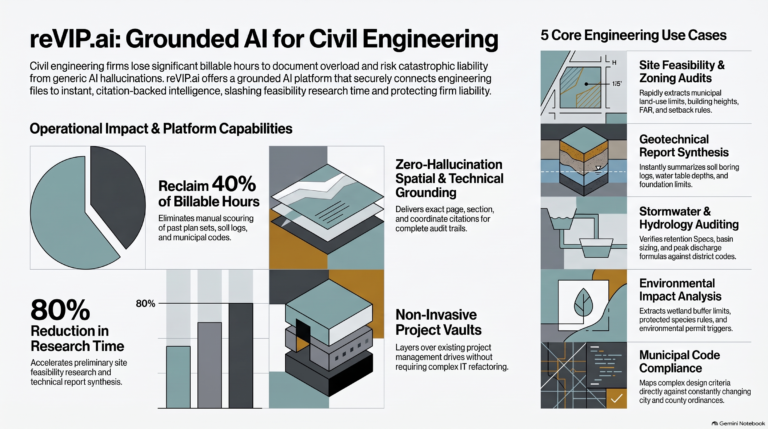


reVIP.ai is a grounded AI platform designed for the civil engineering and site development ecosystem, establishing a direct link between unstructured project files—such as CAD notes, geotechnical logs, and municipal codes—and generative AI reasoning.
By leveraging secure Project Vaults and a non-invasive architecture, the system delivers zero-hallucination spatial and technical grounding with exact page-level citations to eliminate design errors, data silos, and liability risks.
Ultimately, the platform automates core workflows like site feasibility audits, stormwater checks, and agency comment tracking, reducing preliminary technical research and report synthesis time by up to 80%.
Mitigating Professional Liability: Eliminating AI Hallucinations in Civil Engineering & Site Design addresses the severe legal, financial, and regulatory risks civil engineering firms face when ungrounded commercial AI models misquote municipal codes or miscalculate design parameters.
The whitepaper demonstrates how reVIP.ai eliminates these Errors & Omissions risks through Zero-Hallucination Spatial & Technical Grounding, explicitly anchoring every insight and calculation summary to exact page, line, and sheet-level citations within primary project files.
By deploying non-invasive Project Vaults as a secure Single Source of Truth across engineering disciplines, firms safeguard their professional practice against liability while cutting preliminary technical research and report synthesis time by up to 80%.
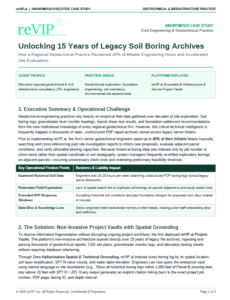
This anonymous case study examines a regional geotechnical engineering practice that was losing up to 40% of billable hours searching through 15 years of static PDF soil boring logs, groundwater records, and lab reports trapped in legacy server directories.
To resolve this operational bottleneck, the firm deployed reVIP.ai Project Vaults, leveraging Zero-Hallucination Spatial & Technical Grounding to index its historical geotechnical archives into a searchable Single Source of Truth anchored by exact page, boring ID, and depth interval citations.
As a result, the firm reclaimed 40% of billable engineering hours, accelerated preliminary site feasibility research and RFP proposal drafting by 80%, and eliminated redundant soil borings on adjacent development parcels.